

Research project “H2 districts” successfully completed: How hydrogen fuel cells support the power grid
Dübendorf, 20.04.2026 — Hydrogen fuel cells are fundamentally suitable for supporting power grids in district energy systems during peak load periods and for integrating hydrogen into building services systems. This is shown by a research project carried out by Empa, the Hälg Group, the Osterwalder Group, and H2 Energy AG. The project also focused on reducing CO2 emissions through the use of environmentally friendly hydrogen.
To reduce CO2 emissions in the building sector, electrically powered heat pumps are central. However, on cold days with high heating demand, their use causes peak loads in the electricity grid. The growing number of electric vehicles also places additional strain on the grid. This requires not only expanded electricity generation capacity, but also an expansion of distribution networks.
A promising alternative solution to this challenge lies in the use of locally stored hydrogen as a powerful energy storage and the use of fuel cells for electricity and heat generation. The electricity produced by the fuel cells can be used on site to operate the heat pump, while the resulting waste heat supports building heating demand. Direct charging of electric vehicles is also possible, further relieving the electricity grid. The use of hydrogen produced from surplus generation, for example from solar PV or hydropower plants, is particularly environmentally friendly.
Operating principles and practical operation studied
In collaboration with the Hälg Group, the Osterwalder Group, and H2 Energy AG, Empa researchers investigated the use of stationary H2 fuel cells to avoid peak loads in district energy systems. For this purpose, a newly developed special fuel cell system was used that not only supplies electricity, but, via a special heat exchanger, can also provide medium temperatures of around 35 °C to the district heating network in the NEST innovation building and Empa campus in Dübendorf.
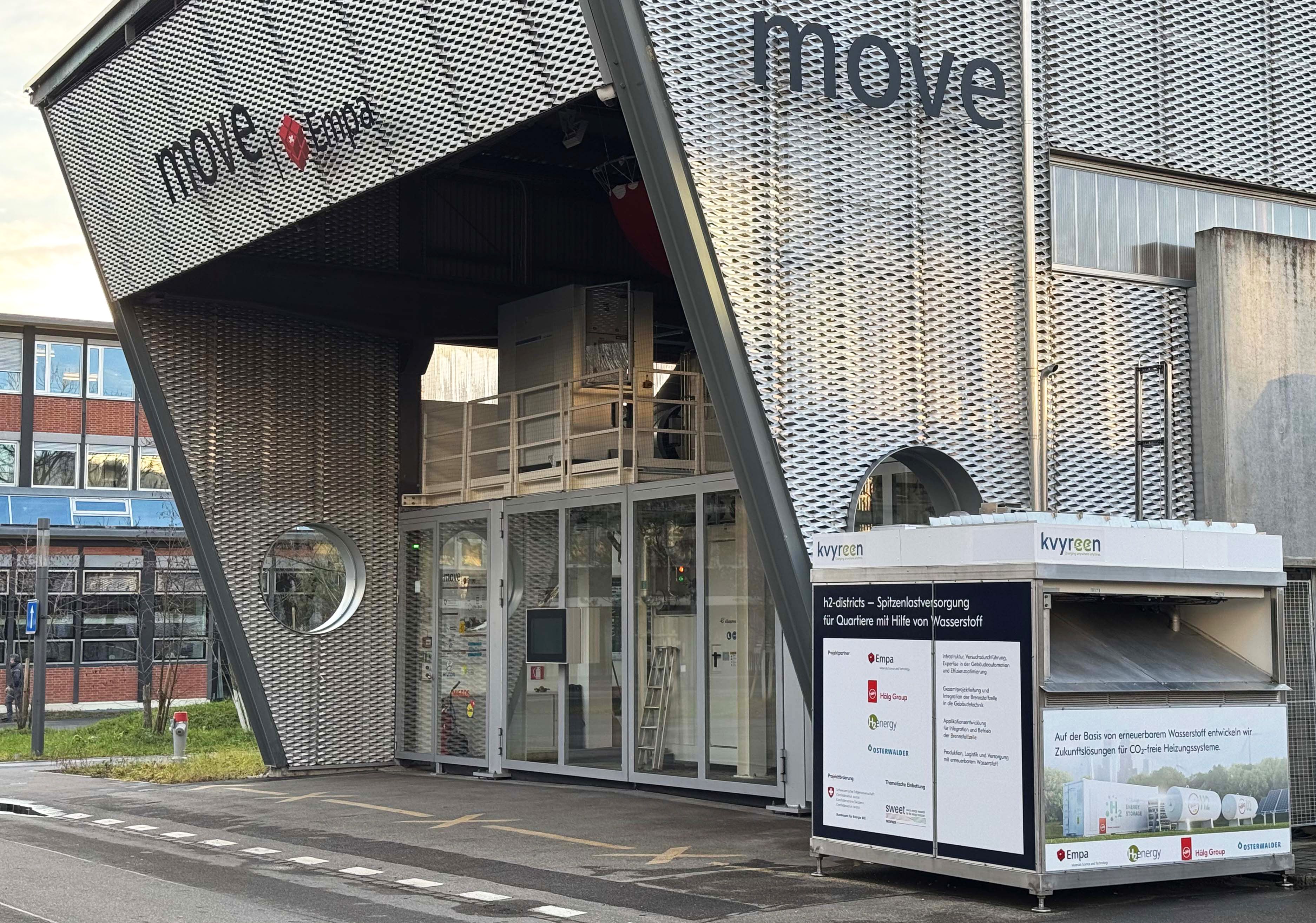
Between October 2023 and September 2025, the operational fundamentals and a simulation model for the design and operation of such peak load supply were developed. A test facility was set up next to the mobility demonstrator move on the Empa campus in Dübendorf and used in a real-world application in the ehub, Empa’s energy research platform, to validate operating parameters and CO2 savings potential. As part of the SWEET PATHFNDR consortium's pilot and demonstration project, the research project was supported by the Swiss Federal Office of Energy.
Hydrogen smooths electric and thermal load peaks in buildings
The results of the two-year project phase were consistently positive: the system efficiencies achieved in operation reached up to 48% electrical and up to 50% thermal, with an average total efficiency of well over 90%. The targeted smoothing of load peaks, applied to the entire NEST innovation building, reduced total peak load costs by more than 10%. Sensitivity values regarding peak load fees and annual energy demand could be estimated for the fundamental economic viability of such a system.
“Our experiments showed that fuel cells can effectively balance electrical and thermal peak loads in buildings. It became clear that hydrogen-based peak load coverage is technically feasible and provides valuable insights for controlling complex energy systems,” says Binod Prasad Koirala, Deputy Head of Urban Energy Systems at Empa. When green hydrogen is used, the fuel cells also make a measurable contribution to CO2 reduction and thus become an important building block needed for a resilient and low-carbon energy system.
Possible application areas for such fuel cells include sites or urban districts where air-to-water heat pumps dominate heat supply, or sectors with regularly high peak load demand, such as schools, sports halls, swimming pools, hotels, and logistics centers. However, the economic benefit for each application area ultimately depends on various additional factors, such as future electricity prices, power charges, and possible CO2 prices.
Information
Dr. Binod Prasad Koirala
Urban Energy Systems
+41 58 765 4683
binod.koirala@empa.ch
Andrea Orlando
Hälg Group
T +41 71 243 37 30
andrea.orlando@haelg.ch